
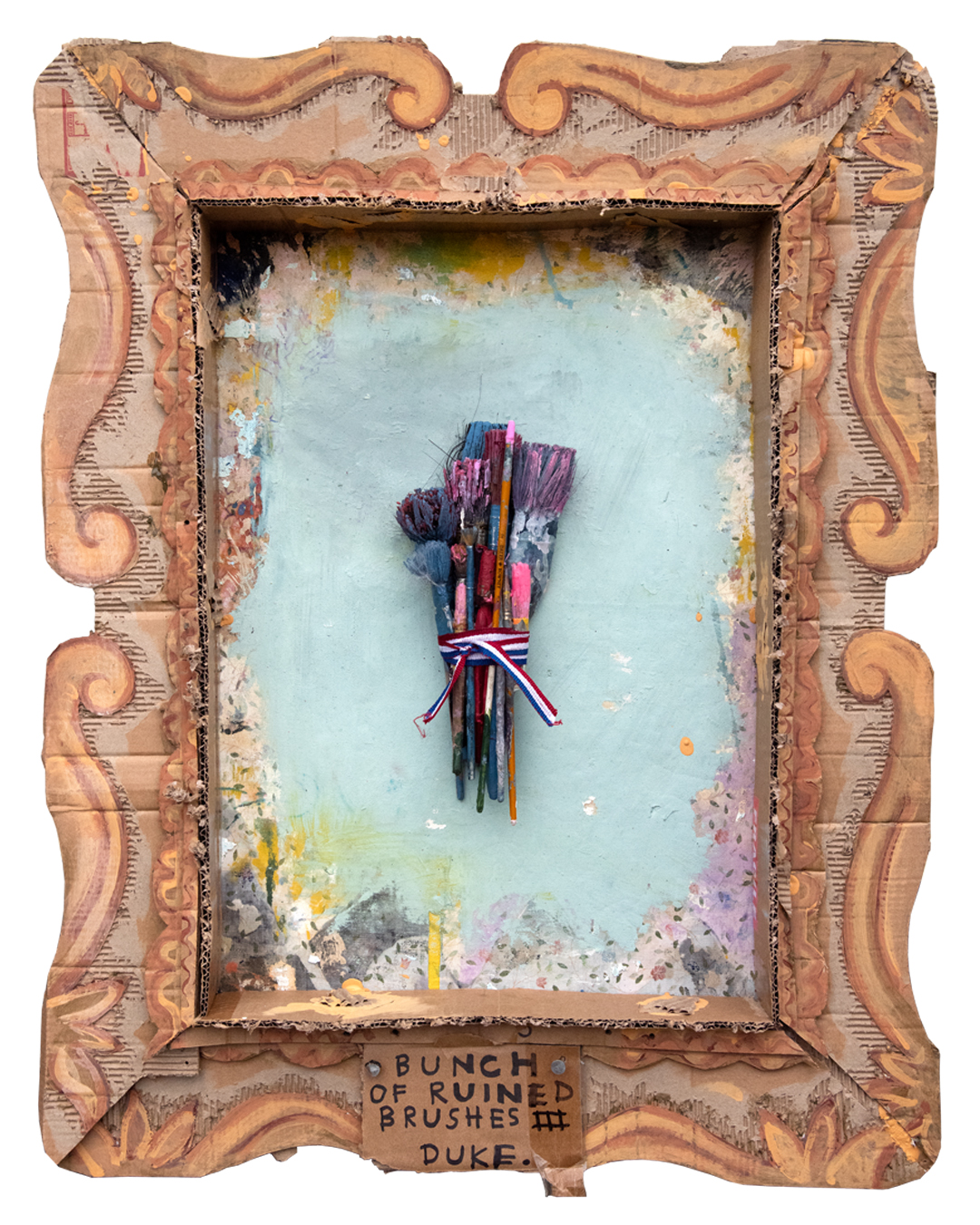
Ruined paint brushes, ribbon, emulsion and felt tip pen on cotton and canvas in cardboard frame
75x60x10cm
A collection of unwashed paint brushes, rendered unusable, arranged and bound to resemble a bouquet of flowers.
From artefact to art and back again
The series of Ruined Brushes considers the way an artist’s tools and personal remnants are presented within the museum. Brushes, personal correspondence, photographs, sketches and other traces of an artist’s working life are frequently preserved and displayed as artefacts and imbued with a significance beyond their original function.
They become objects through which audiences are invited to know the person who held the brush, made the mark or wrote the words, as though something of the artist’s spirit remains embedded within them, and help construct the mythology and narrative of an artistic career. Jimi Hendrix’s albums are his art, but his guitar, his shoes or even his own art collection are perceived as still containing traces of an unknown divine power, like his electrical charge passed through them all on its way to us. Go to an auction and this will be reflected in an object’s value.
Ruined Brushes collapse this distinction between artwork and artefact. Rather than waiting to be discovered, preserved and retrospectively authenticated by an institution, the brushes have been incorporated into the artwork itself by the artist. The tools are not presented separately as evidence of the making of the work — they are the work.
The brushes carry the physical evidence of making — accumulated layers of colour recording countless gestures and decisions. By presenting them as a bouquet, the work suggests that what is normally treated as waste can itself become a record of creativity and labour, transformed into something that resembles a precious still life. A ruined paint brush can be rubbish, a tool, evidence of labour, or an artwork depending upon where it is placed and who has the authority to define it.
Promoting self-deprecation
Celebrated artists are often perceived as geniuses, and their actions can be retrospectively interpreted as deliberate, meaningful or visionary. Here, however, the brushes became art because of a simple mistake: they were not washed after use. Their transformation into an artwork is therefore also an act of self-deprecation, refusing the image of the artist as infallible genius and acknowledging the ordinary carelessness from which a good idea can emerge.
The work suggests that creativity does not always arise from mastery or perfection, but can develop through accident, neglect and error. In a world increasingly shaped by pressure to perform, improve and achieve excellence, it offers a gentle reminder that we might all take ourselves, and our mistakes, a little less seriously.
The bouquet
The Ruined Brushes are arranged like a bouquet of flowers, introducing a deliberately sentimental and romantic gesture into the work. Flowers are traditionally given as gifts to express love, gratitude, remembrance or affection; but here, the gesture mirrors the histories of the brushes themselves.
Each has entered the artist’s practice through an act of acquisition and exchange: some were gifted to the artist, some were bought second-hand, while others had previously served an entirely different purpose, such as decorating interiors. They are therefore objects with lives that pre-date their role within the artist’s studio. Their accumulated layers of dried paint extend this history further. The colours embedded within the brushes can be traced directly to paintings elsewhere in the artist’s catalogue, making them physical remnants of previous works and records of the artist’s creative journey.
The bouquet is consequently both a gift and a form of self-portrait — a gathering of objects, relationships, previous lives and artworks. What might initially appear as a romantic still life is therefore also an archive: a bouquet made not from flowers that will inevitably wilt, but from tools passed from one generation to the next… this of course will soon become an act of the past as contemporary tools become less durable and less aesthetically desirable.
Framing ‘skimpflation’
The cardboard frame of Ruined Brushes III becomes a direct comment on the contemporary phenomenon of ‘skimpflation’ — the gradual reduction in the quality, materials or craftsmanship of products and services while their price remains the same or increases. Traditionally, the frame serves to distinguish the valuable artwork from the world around it, transforming an object into something worthy of contemplation and preservation. Here, that hierarchy is turned against itself: the frame is an imitation, the materials are discarded, and the artwork is made from the remnants of making.
The ornate form deliberately recalls a period in which frames, buildings, furniture and clothing were constructed with an emphasis on material quality, durability and skilled craftsmanship. Here, that visual language of permanence is reproduced in one of the cheapest and most disposable materials available. Cardboard, crudely cut and shaped to imitate the carved wood and gilded ornamentation associated with grand art galleries, museums and aristocratic interiors. A metaphor for a wider shift in the culture of production: from artisans making things to last towards companies making them as cheaply and efficiently as possible.
The frame therefore becomes more than a container for the artwork; it is itself an example of the condition the work is examining — a cheapened imitation of something once built to endure. Its apparent grandeur and actual fragility expose the contradiction between the value we continue to place on the appearance of quality and the diminishing value placed on quality itself. A lavish, gold frame tells us that what we are looking at is important. The discarded materials ask why. It questions the structures we build around objects — and the curious moment when something discarded becomes valuable simply because we have decided to look at it differently.
Each new Bunch of Ruined Brushes becomes a new layer of planned obsolescence.

