
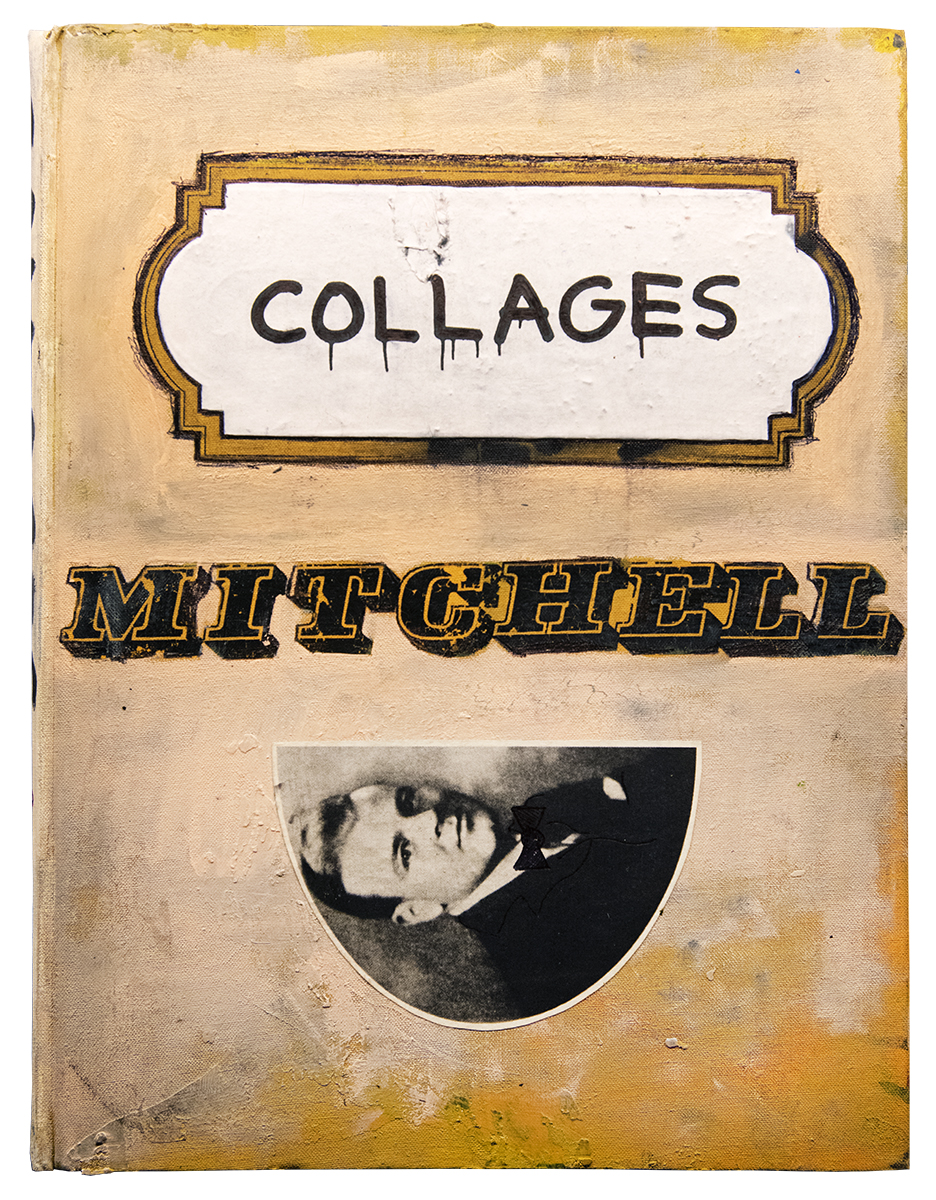
A reappropriated Screen Book Tabloid
PRIVATE COLLECTION
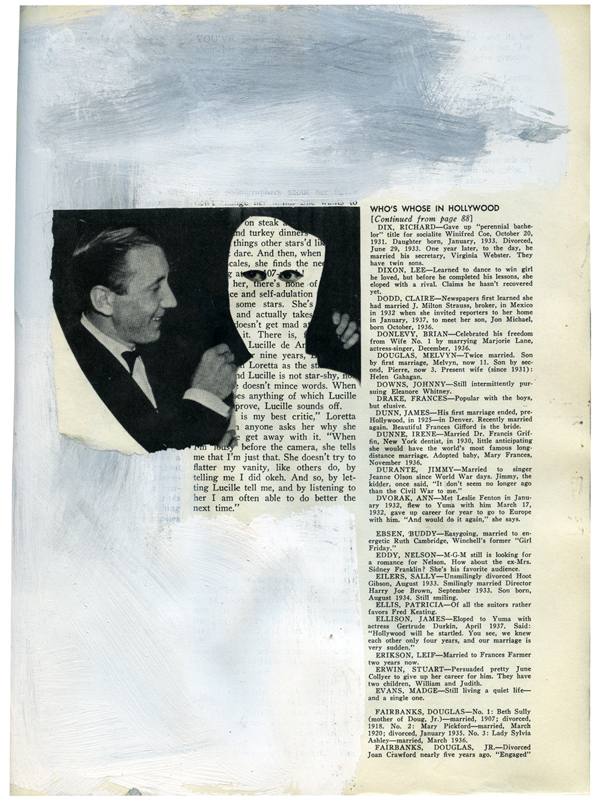
Fan magazines like Photoplay, Screen Book and Movie Mirror served a cinema-going public a diet of Hollywood glamour and celebrity gossip for over half a century.
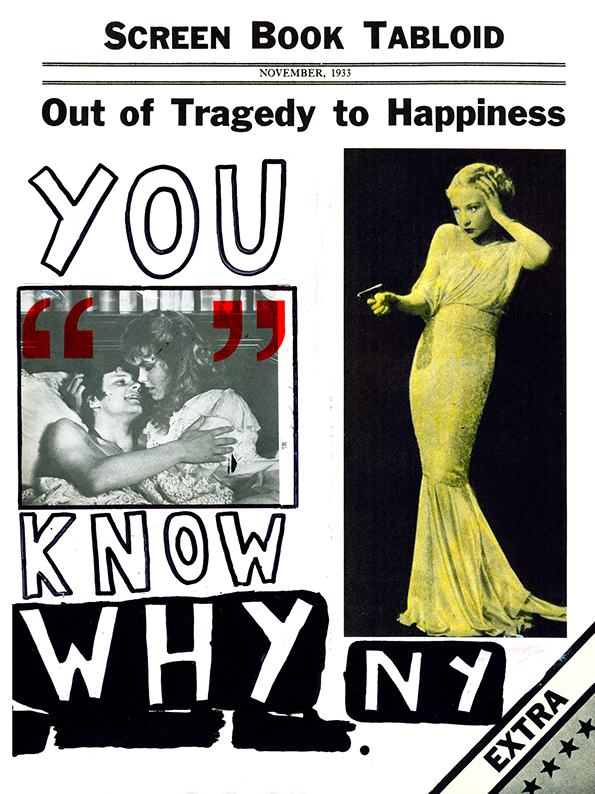
Some had ‘tabloids’ that replicated the layouts of newspapers, coupling posed pictures with bombastic headlines – they could be considered the precursor to the celebrity magazines and gossip websites of today.
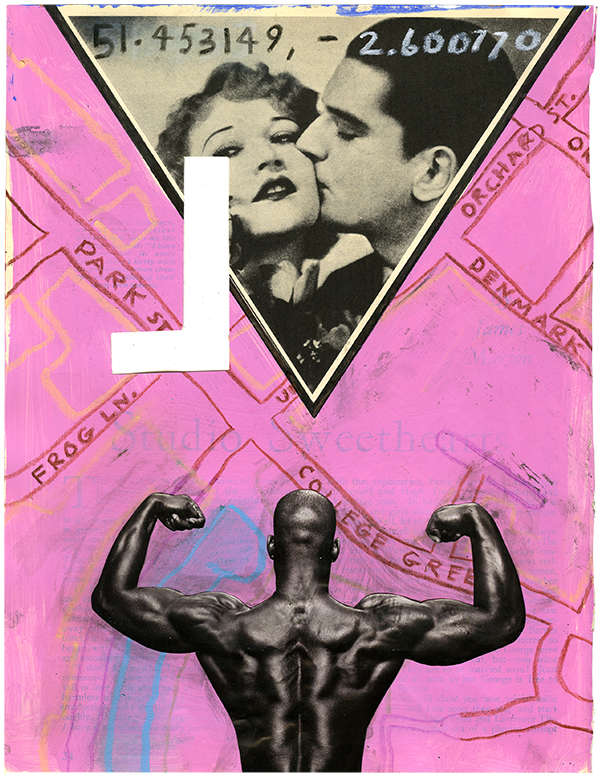
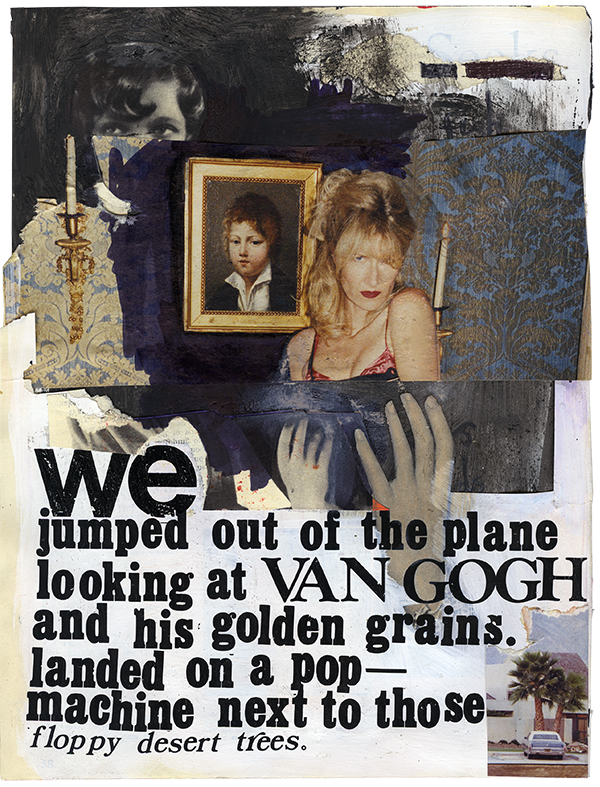
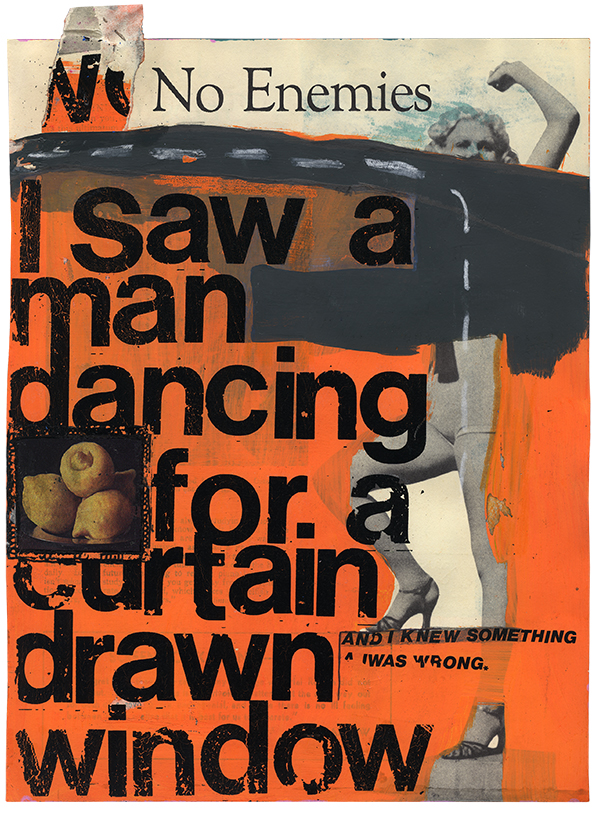
This Screen Book Tabloid book (1933) is a collection of such articles, ripped-up and reassembled with paint, crayon and Letraset to show great minds occupying the same level of visual space as ‘celebrity’.
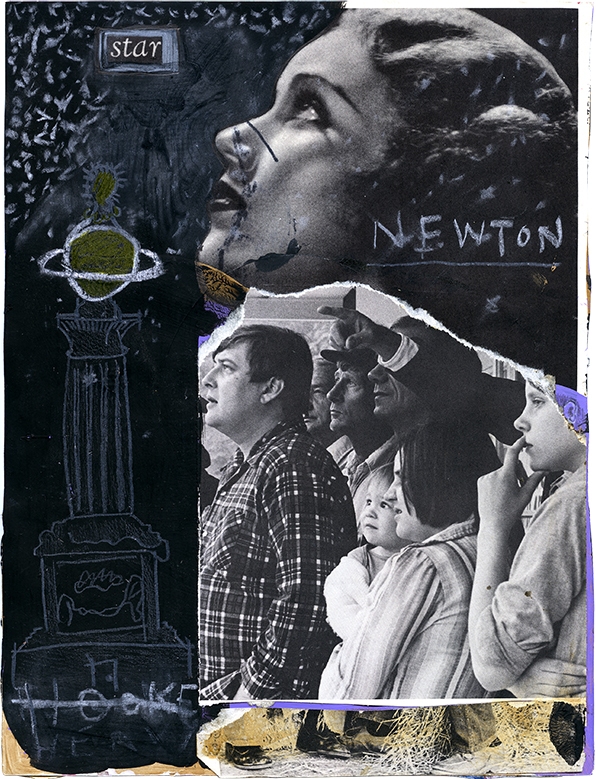
Illustrating a bitter feud between Sir Isaac Newton and Robert Hooke that resulted in Newton trying to erase Hooke from history – featuring the pillared monument to the Great Fire of London, in which Hooke intended to mount a telescope to observe the star Gamma Draconis from a couch inside it’s base.

In demonstrating links between electricity, magnetism and light in his experiments at the Royal Institution, Faraday had discovered a deeper unity of nature – setting in motion a revolution “…that dwarfs all the shots fired and bombs ever detonated in the sheer magnitude of its effect on our civilisation, […] this opened the door for Einstein and all the physicists who came after him to glimpse the interplay of hidden primal forces in the universe.” – Neil deGrasse Tyson
Initially however, the prevailing view among his fellow scientists was that Faraday’s invisible lines of force and their effects on gravity were nothing more than a dream. They needed to see his ideas expressed in precise equations in order to take them seriously… Enter the greatest theoretical physicist of the 19th century – James Clerk Maxwell, who set out to give these invisible fields of force a precise mathematical formulation.
When Maxwell translated Faraday’s experimental observations on electromagnetic fields into equations, he discovered an asymmetry that showed Faraday’s static field to be waves that spread outward at the speed of light. This formed the basis on which we are now able to send pictures and sound around the world in the blink of an eye, the mathematics upon which the device you are using to read this relies.
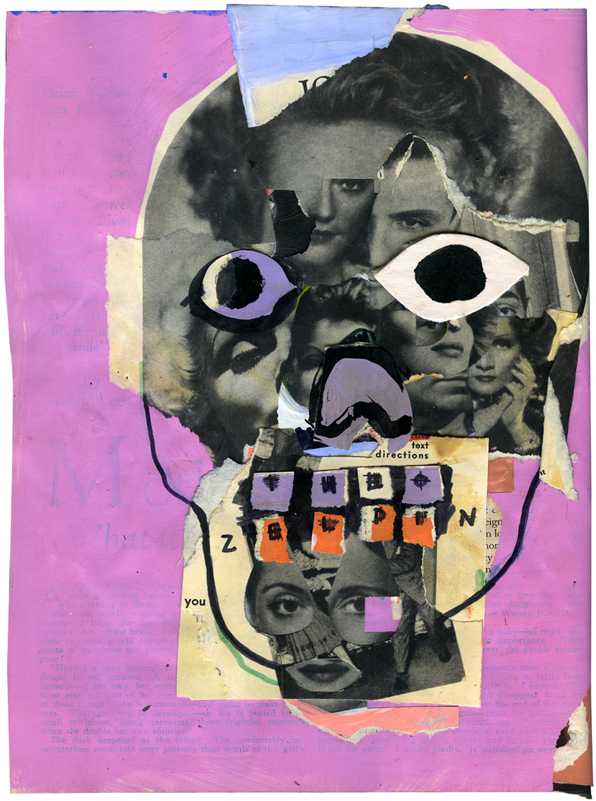
A human skull made up of everyone that came before, with a nod to Georg Hegel and Theodore Zeldin.

Despite a life of remarkable discoveries, inventions and publications, some might argue that one of Edmond Halley’s greatest achievements was as a facilitator. To bring the reclusive Isaac Newton’s genius to the world was to bring forth a scientific revolution, recalibrating the human imagination from a pre-scientific world ruled by fear to one of wonder and endless questions. One might say that by setting Newton free, Halley set us all free.
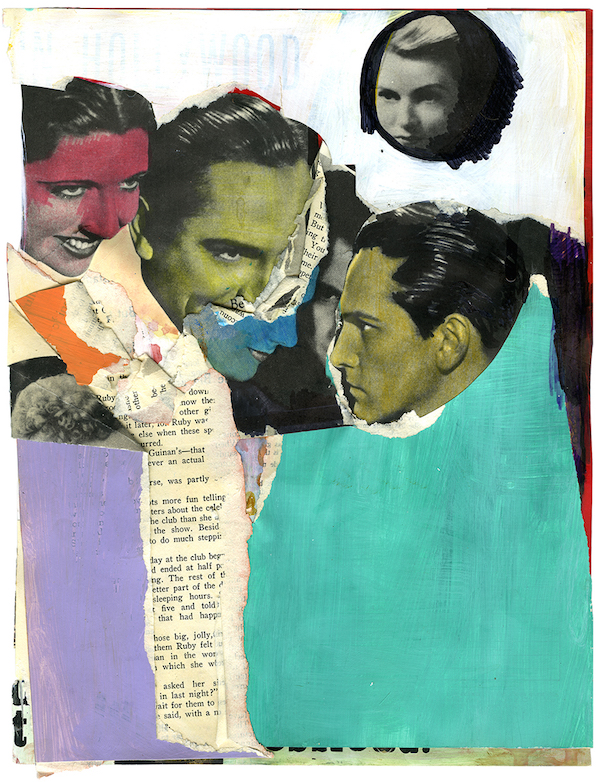
After a childhood fraught with hardship, Joseph von Fraunhofer (1787-1826) went on to become the world’s most renowned maker of optical glass. Whilst investigating the refraction of sunlight through a prism he noticed dark vertical lines across every colour of the spectrum. These dark lines are the shadows cast by atoms.
“When you look at a star through a spectroscope, you see the dark lines from all the elements in its atmosphere. Show me the spectrum of anything, whether here on earth or from a distant star, and I’ll tell you what it’s made of.”
Neil deGrasse Tyson
His spectral lines revealed the composition of far away objects and their motion, but also that all the planets, stars, galaxies, us and all of life are made from the same stuff. Fraunhofer showed us what (and who) was hiding in the light.

“Men dream of women, women dream of themselves being dreamt of”
John Berger (Ways of Seeing, 1972)
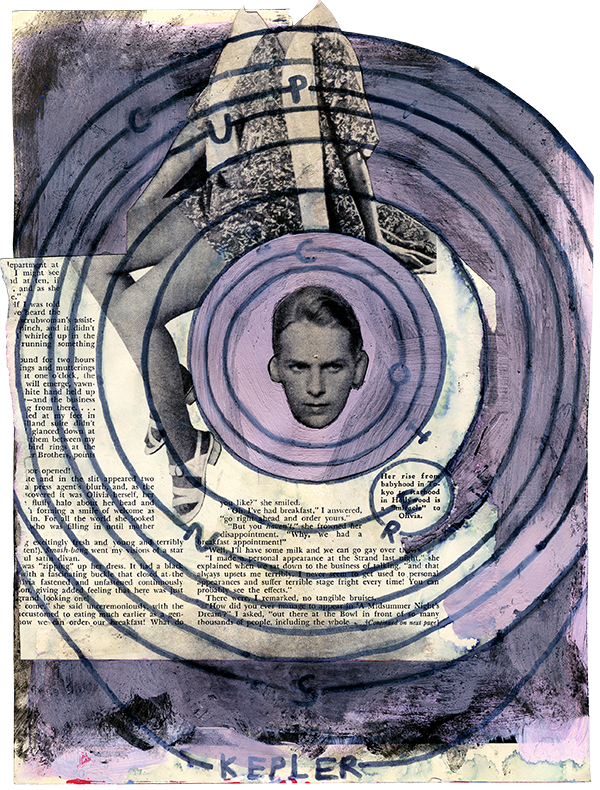
For 2000 years people accepted, supported by Christian dogma, that the Earth was the centre of the universe. Through his observations with rudimentary instruments, Nicolaus Copernicus was able to prove that, in fact, everything orbits the sun. Johannes Kepler would later prove these orbits were not round, but elliptical.
His theories were rejected by the scholars of his time and were banned by the Catholic church for 300 years after his death – denouncing thoughts that conflicted with its doctrine as heresy, a sin and a crime – punishable by burning at the stake. Understandably Copernicus kept his theories largely secret until the end of his life – the first copy of his book Astronomia Instavrata, placed in his hands as he lay dying.
The desire of the church to smother scientific illumination brought about the Inquisition – through which Galileo was sentenced to house arrest for the rest of his life. But the spark of the revolution had already set fire to the European imagination.
Copernican theories launched mankind on a voyage of exploration and discovery – replacing belief, mythology and magic with observation and questioning. In removing Earth from the centre of the universe Copernicus (Mikołaj Kopernik) placed us back at the centre of our own individual universes, with the freedom to choose what to investigate.
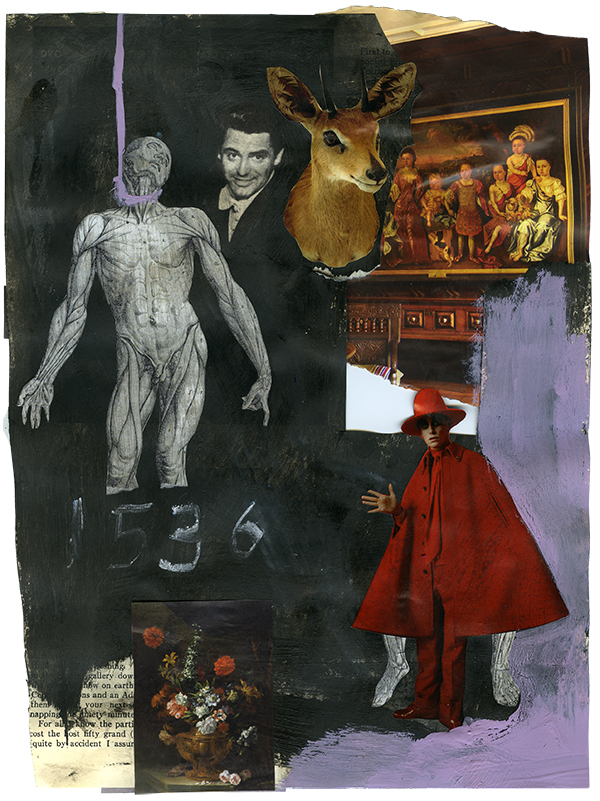

It’s 1536, a criminal has been hung and left to rot. Along comes a 22 year old medical student, he jumps up, grabs the bottom of the legs and pulls. With a terrible ripping sound they come off in his hands and he runs away into the night.
What he was doing was very dangerous, body-snatching is illegal, not only was he risking jail and personal ruin, he was challenging long established ideas. At his medical school there was only one set of anatomical textbooks written by Claudius Galen. Written 1300 years before, they were largely based on animals like pigs and apes. He decided to do something that would have outraged and disgusted his contemporaries, dissect and examine a human body himself.
When Andreas Vesalius announced that much of what the textbook said was incorrect, he became extremely unpopular. In all he corrected over 200 mistakes and identified the location of all the major organs, nerves and muscles in the human body. Thanks to him anatomy and therefore surgery took a massive step forward.
In this parody, Eddie Redmayne, who portrays another revolutionary scientist, Stephen Hawking in the Theory of Everything, plays the role of Vesalius – cut from Vogue Magazine’s 100 year anniversary issue along with the limbs he’s stolen.
In their respective TED talks Tricia Wang and Jer Thorp speak quite wonderfully about meaning and the human narrative in the context of big data – each with an anecdote regarding a mobile phone company.
Tricia Wang shows the dangers of being addicted to valuing the measurable over the immeasurable. How a combination of quantitative (big data) and qualitative (thick data – which offers “incredible depth of meaning”) gives a far more holistic picture for informed decision making in uncontained systems involving human dynamics.
In building visual tools as a way to understand systems Jer Thorp shows us how the seemingly abstract numbers of big data are tied to pieces of the real world – “putting these pieces of data into a human context gives it meaning”. Revisiting travel history for example reveals incredibly emotional and life-changing moments captured in the numbers.
Since the full constellation of 24 satellites operational in 1993, GPS has revolutionised the way we all move, communicate and do business.

As soon as Nicéphore Niépce managed to take, what can be described as, the first photograph in 1826, the stage was set for real life images to be permanently fixed. Louis Daguerre began working with Niépce, who died shortly after, leaving Daguerre to develop a technique which fixed a positive, one-of-a-kind image to a copper plate – the Daguerreotype. The French government was so impressed, they rewarded him with a pension for life.
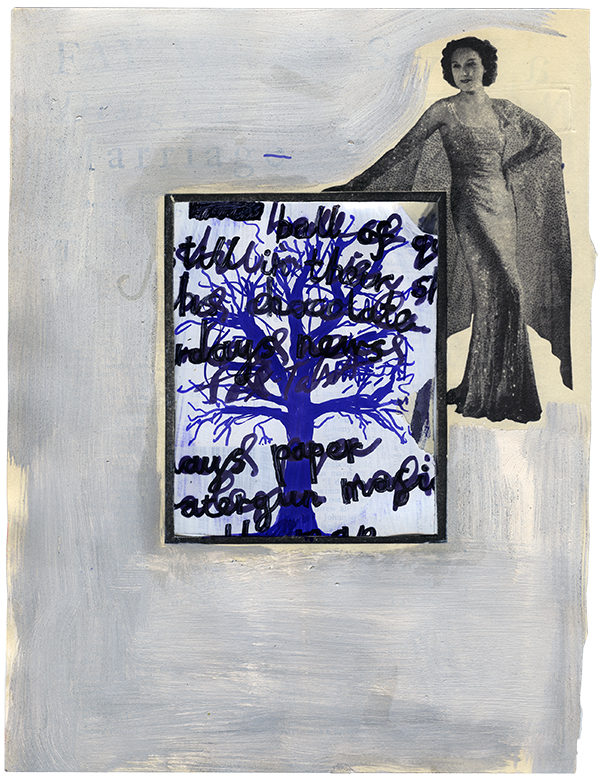
News of this breakthrough came as a shock to Henry Fox Talbot, who had been working on his own photographic process at Laycock Abbey for some 5 years, but had not deemed it ready to reveal. His calotype was a negative image fixed on paper that could be reproduced as unlimited positive prints.
Fox Talbot couldn’t match the quality of the Daguerreotype, but had moved photography forward into the world of printing and reproduction. Despite the fact that Fox Talbot’s process would go on to form the basis of photography up until the digital age, Daguerre was the one who would become rich, famous and celebrated during their lifetimes.


 Duke Mitchell